
The Garden and the Storefront
Sometimes the deepest transmission of karate happens far away from storefronts, rankings, and commercial success.

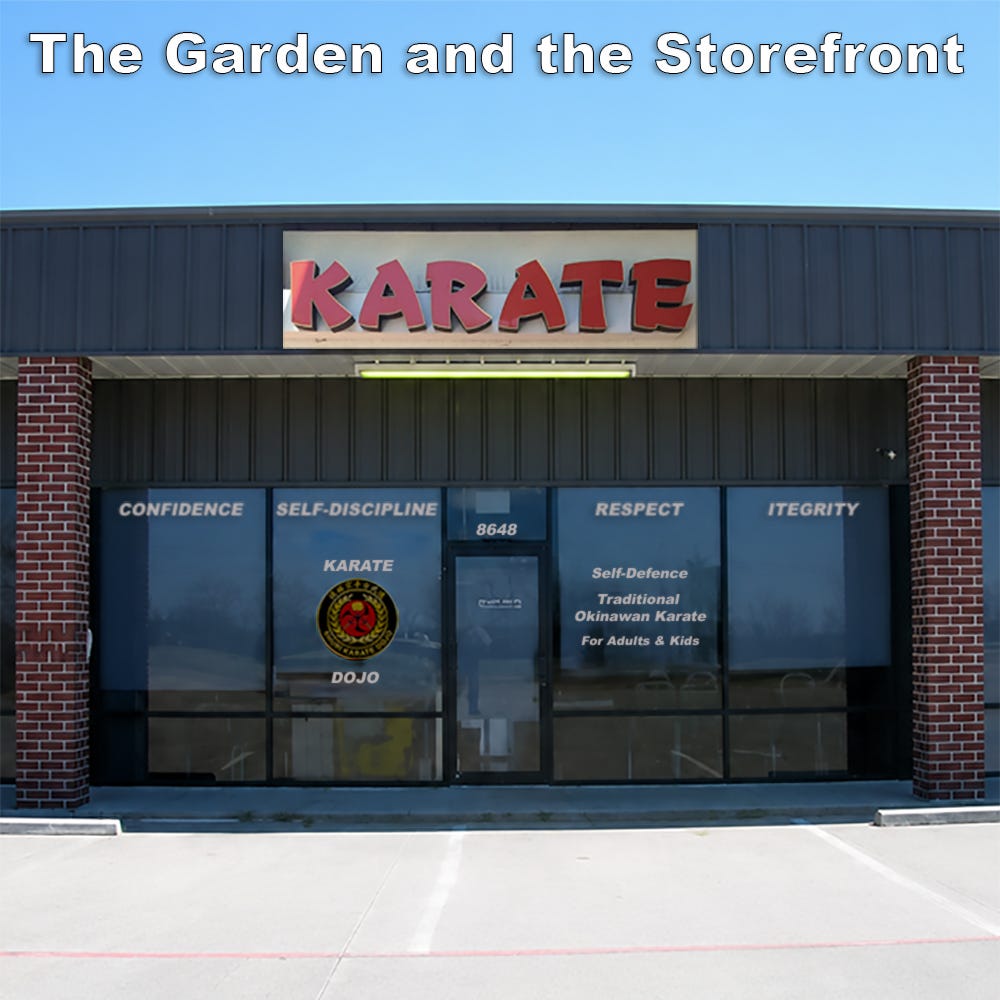
When I first arrived in the United States, I was struck by the sheer scale of the martial arts landscape. Coming from the UK, my formative years of training and teaching were spent in the tradition of the rented hall instructor. We packed our gear into the boots of our cars and drove to drafty church halls, local sports centers, and sometimes schools. We set up, we trained, we packed up, and we went home. A permanent, dedicated facility was a rare luxury.
When I eventually became part of a storefront dojo here in the US, it felt like a significant milestone. In a culture that often values a commercial footprint as a visible marker of achievement, having a permanent mat and a sign on the window felt like validation that I had finally “arrived”.
A few years later, the disruption of the COVID-19 pandemic forced a total re-evaluation. Like many instructors, the financial realities of that period eventually led me to close our doors. Today, my teaching happens on a much smaller scale - with a number of dedicated students training in a home garden dojo.
It is easy to view a shift like that through a negative lens. When you look around and see thriving commercial schools on every other street corner, modern metrics can quietly trick us into measuring our worth as educators by square footage, student rosters, and profit margins.
But as the dust settled, I began to see the transition differently. Losing the storefront did not diminish the transmission of the art. If anything, it returned the training to something closer to its historical roots.
True depth cannot be mass-produced.
As karate spread internationally during the twentieth century, the arts naturally became more structured and standardized so they could be taught efficiently to larger groups. Ranking systems, formal curricula, and repeatable teaching methods helped karate reach millions of people across the world.
It was an extraordinary achievement.
But every large-scale system involves compromise. A curriculum designed to teach large numbers of people within limited timeframes naturally prioritizes the what and the how over the highly individualized why. It leans toward accumulation - learning the next kata, earning the next belt, meeting the next requirement - rather than slowing down long enough to deeply explore the principles underneath.
Over time, the commercial storefront dojo became the dominant model.
Running a commercial school is a massive undertaking. High rents, insurance costs, utilities, advertising, and staffing mean an instructor cannot simply be a martial artist - they must also become a business administrator. To survive financially, the model often depends on broad accessibility, high student retention, and predictable structures that keep students progressing.
This is not a criticism of commercial instructors. Many are excellent practitioners and dedicated teachers doing their best within a difficult economic reality. But the structure itself inevitably shapes the nature of the training.
The curriculum can gradually stop being a guide and start becoming a ceiling.
There is rarely time to slow down and explore subtle biomechanical details, individual body mechanics, or personal adaptations when forty students are on the floor and the next class begins in fifty minutes.
Yet when we look back at the older Okinawan traditions, we often see a very different blueprint.
Many Okinawan teachers worked with small groups in modest private settings - homes, courtyards, backyards, or small personal training spaces. Chojun Miyagi taught small groups. Choki Motobu often preferred informal instruction. Kanbun Uechi also worked closely with limited numbers of students.
They kept their circles small not because they lacked ambition, but because they understood something fundamental: true depth cannot be mass-produced.
In a smaller private dojo with only a few students, the entire nature of the training changes.
Without the pressure of a commercial lease or the demands of a large student base, an instructor no longer has to chase market trends or rush students through a checklist to maintain retention. If a technique does not work for someone because of their size, age, mobility, or body structure, you do not simply move on to satisfy a syllabus requirement. You stop. You examine the mechanics. You experiment. You adjust. You search for an application that genuinely works for that individual.
The goal shifts away from producing identical students performing identical movements. Instead, the focus becomes helping each individual express universal principles through their own body and understanding.
A storefront dojo can absolutely be a wonderful chapter in a martial artist’s life. I know it was for me. For many instructors, teaching is also how they support their families and devote themselves fully to the arts. There is nothing inherently wrong with that, nor does a commercial school automatically diminish the quality of instruction.
But over time, I have come to realize that visibility is not the same thing as depth, and a large student roster can sometimes create the illusion of progress.
Success in the martial arts is not ultimately measured by the size of the building, the number of belts awarded, or the amount of monthly revenue generated.
It is measured by the quality of transmission between teacher and student.
It’s found in those quiet, unhurried moments in a small room where a student suddenly pauses, looks up, and finally understands why something works.
For those seeking the heart of the art, the garden will always beat the storefront.
Dear Sensei Carter:
This post resonates with me.
I’d say about half the training I’ve done has been in commercial establishments, and the other half in garages, driveways, city parks, back yards, tiny living rooms, even under bridges when it was raining and there was nowhere else to train.
In many ways, these impromptu / makeshift training venues were a lot more fun than the formal training at the commercial dojos. We could take our time; there was no class starting after ours. Sometimes passersby or bystanders would offer their tips and suggestions (and sometimes these were actually pretty helpful.)
A famous writer whose name I’ve forgotten, said about writing (I’m paraphrasing:) “You need a typewriter and a place to sit.”
With martial arts it’s: “You need another person, and a place with enough room to swing your fists / do your kicks / grapple / whatever.”