The Family Art Without a Name
Not all karate was preserved in the names history remembers.

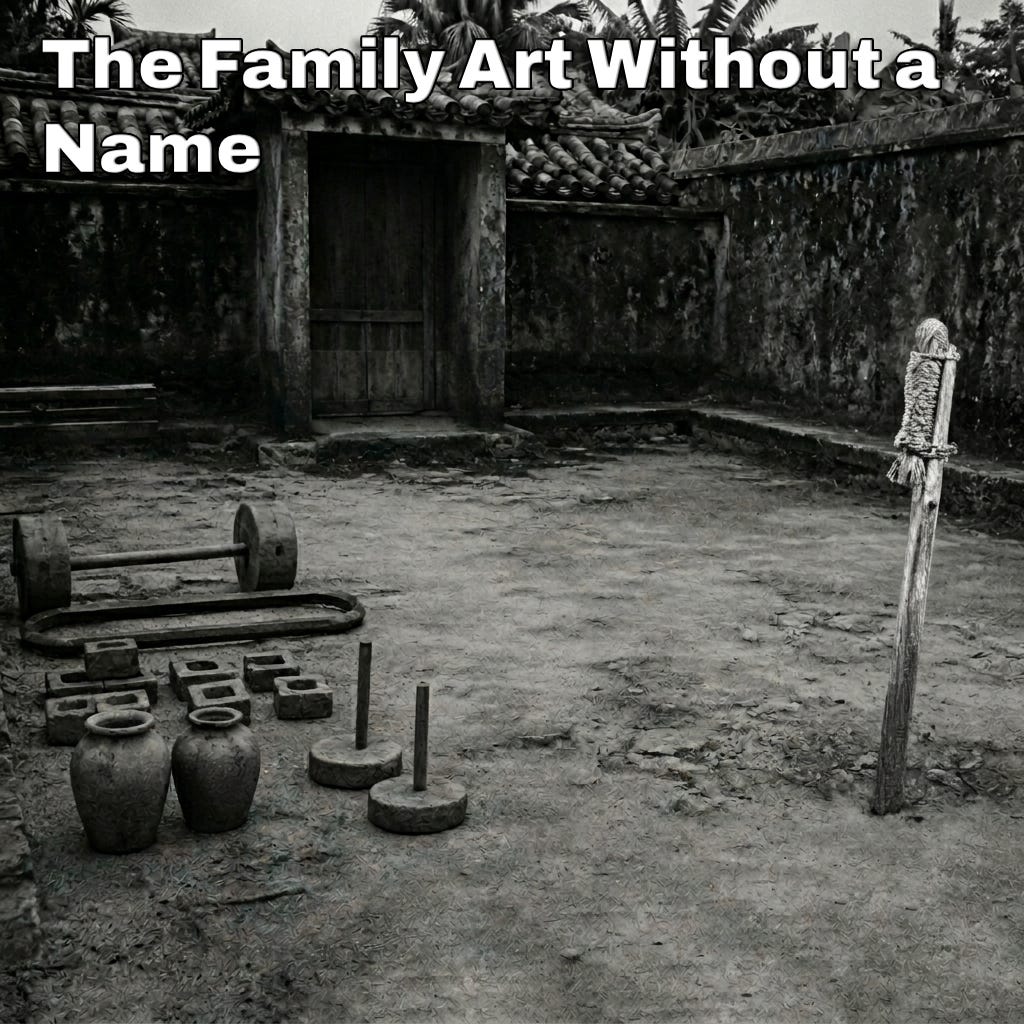
When we look back at Okinawan karate, we tend to remember the names that survived: the teachers who wrote things down, taught openly, or became connected to later recognized systems. We remember the broad labels, Shuri-te, Naha-te, Tomari-te, and later the formal schools that grew from them.
But it’s worth asking how much more existed quietly beneath that surface.
Before karate became organized and public, much of it was personal. It passed from teacher to student, from family member to family member, through small circles of trust. Not everything had a name, a badge, a syllabus, or a written record. Some methods existed only as private practice, personal interpretation, or family memory. Okinawan karate was shaped by local practice, Chinese influence, and individual transmission, but not every small method became a named school.
Where does a family art actually live?
It’s tempting to think a family tradition must have had its own unique kata. Some probably did, preserving a particular form known only to them. It’s equally possible that many of those forms are gone now, absorbed, changed, or forgotten.
Early in my training, I was never told that there was a specific family kata. I never asked, either. Looking back, that seems like an obvious question, but we do not always know what to ask until years later.
Even so, I don’t think the distinctive part of a family tradition is always a separate kata at all. I think it lives in the method.
A teacher can practice the same kata as everyone else and still preserve something completely different through it. The sequence looks familiar, but the body use is not the same. The timing is different. The entry is different. The way the hands receive, control, redirect, seize, or strike carries ideas that are not obvious from the outside. Two people can perform the same movement, and one is reproducing the shape while the other is preserving a method.
This is the problem with treating kata as nothing more than a set of external positions. If we only ask, “What kata did they practice?” we miss the more important question:
How did they move, and what did that movement mean?
A family tradition does not need a different kata to be different. It might live in a different way of using the body, entering, understanding distance, or receiving force. A different way of closing, controlling, turning, disrupting. It might be found in drills, in partner work, in small details, in the way one movement connects to the next.
A kata name can be written down. A syllabus can be preserved. But the feel of a method, the timing of a shift, the angle of entry, the pressure of a grip, the way a teacher makes a movement actually work, those things are fragile. They only survive through direct transmission. This is why I have always been cautious about reducing karate to catalogs of techniques. A movement is not preserved just because it has a label, and a kata is not preserved just because its sequence survives intact. Something deeper can be lost while the outer form stays exactly the same.
Kata may preserve the shape of the art, but the method is kept alive through practice, correction, and application.
The art lives in how the kata is understood, drilled, corrected, and passed on. It lives in the principles that make the movement work, and that is exactly why private traditions are so hard to trace. If a method was never named, never written down, never taught outside a small circle, history has very little to hold on to. The practice was real. It just was not visible in the way modern systems are visible.
I don’t think of these as hidden ancient styles with a neatly preserved syllabus, waiting to be discovered. That would be too easy to claim and too hard to prove. I think of them as family-connected practices and personal transmissions, some of which only received formal names much later, if they received one at all.
The name may have come later.
The method came first.
We look for history in names, dates, and formal systems, and those things matter. But in karate’s older and more private forms, history also lives in the body: in how a teacher moved, what he emphasized, what he corrected, and what he chose to pass on.
A family art does not always announce itself as a separate style. Sometimes it lives in the way the hands move, the way the body turns, and the drills practiced quietly, person to person, long before anyone thought to give it a name.
Thank you for your thoughts on this very interesting topic Sensei. This process can also be seen in modern karate, though perhaps to a lesser extent because of the existence of video and social media. Take my own classes for example. 50+ years ago I joined a small local Tang Soo Do club, part of a large UK federation. Back then, there were very fixed ideas on how to train, performance requirements and application interpretations. I cross trained with lots of other karate based groups and their attitudes and ideas were quite similar. As the years progressed, particularly in the late eighties and into the nineties, many of the larger associations splintered and lots of new, smaller groups formed. Many of these were developing their own interpretations or seeing the limitations of the systems which they had formerly been a part. I too was learning that there was much more to be learned by delving deeper into both the history and the practice of martial arts (specifically those with an Okinawan Karate origin). I look at these small groups now: some have fallen by the wayside, some have been absorbed into other large associations, but quite a few persist as small groups, guided by their founder(s) principles and practices in a very similar way to that which you describe. How will their ideas and methods be passed on and how might they be viewed, if at all in the future historical records? - food for thought!