
The Direction of Kata
Direction in kata is not always the direction of the attack. Sometimes it is the lesson of position.

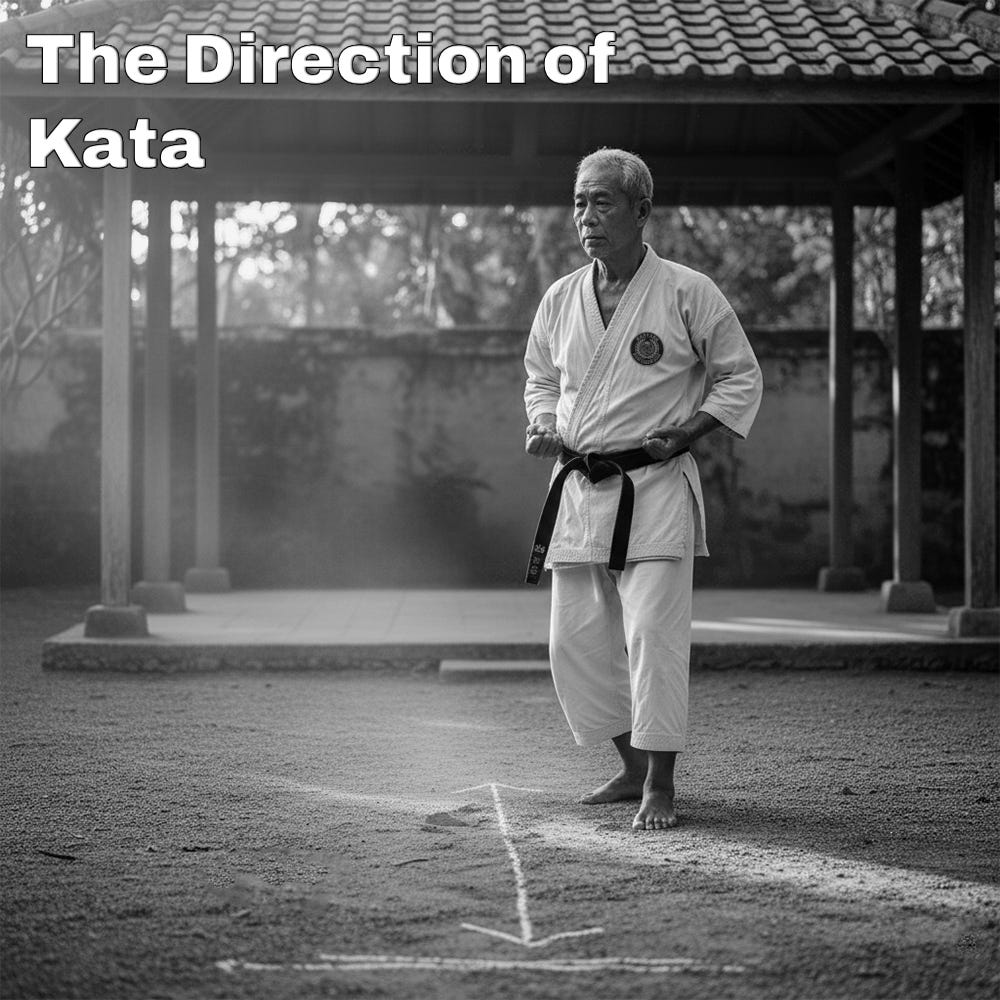
I was asked a good question recently:
Do all kata start with a move to the left? Are there any kata that start to the right?
It’s an understandable question, especially for beginners. Many of the first kata people learn, such as Fukyugata, Gekisai, or the Pinan kata, begin with a movement to the left. After a while, it can start to look as if this is some kind of universal rule.
But it’s not.
Not all kata begin by moving to the left, and even when they do, it’s worth asking what that movement is really teaching us.
Some kata begin to the left. Some begin to the right. Others move straight ahead, working from the center, often with a very different feeling and tactical emphasis.
The more useful question is not simply, “Which direction does the kata move?”
The better question is, “What is that direction teaching us?”
The first thing to clear up is a common misunderstanding. You are not being attacked from the left simply because the kata moves to the left. That idea is often connected to the explanation that kata teaches us to defend against attackers coming from different directions, almost like enemies are standing around us on the points of a compass.
It’s easy to demonstrate. But I don’t think it’s a very realistic way to understand kata.
For me, a more useful starting point is this: imagine the threat is in front of you, close enough to touch, grab, strike, or control you. The movement to the left may then represent your own body movement, taking an angle, moving off the line, changing position, or placing yourself in a more useful relationship to the opponent.
That is very different from saying the opponent is attacking from the left.
If someone is directly in front of you and you move to your left, you may be moving away from their power side, particularly if they are right-handed. Since most people are right-handed, it makes sense that some introductory patterns would first address that more common problem. You are not simply “blocking” something. You are trying to improve your position.
But when a kata moves straight ahead, that can carry its own lesson too.
It may suggest entering, or taking the center. It may suggest closing distance, controlling space, applying pressure, or dealing with contact that is already directly in front of you. It may not be about evading to the side at all. It may be about structure, rooting, forward intent, body connection, and the ability to receive and issue force from close range.
This is why context matters.
Kata from different lines or lineages may often give us a different feeling. One may appear to emphasize angling, shifting, or changing position. Another may appear to emphasize direct pressure, close-range control, and movement through the center. These are not contradictions. They are different lessons. The direction of the kata is part of the teaching method.
It’s not the whole explanation.
This matters because position changes everything.
A small angle can reduce the opponent’s ability to strike with power. It can place you closer to their blind side. It can give you access to the arm, the head, the neck, the balance, or the centerline. It can help you move from being directly in front of danger to a place where you can control, disrupt, or escape.
So the first movement of a kata may look simple, but it can carry a much deeper lesson.
It may teach us not to stand still in front of force, but to receive rather than collide. It may teach us to move our body, not just our arms. It may remind us that the first answer to danger is often not strength, but position.
In other words, the direction of the kata is not the same thing as the direction of the attack.
That distinction is important, because it changes how we study kata. We stop seeing direction as a literal map of attackers around us, and begin to see it as a study of angle, entry, control, balance, and position.
So yes, some kata begin to the left. Others do not. But the real value is not in making one rule for all kata. It is in understanding what each movement is trying to teach.
Of course, this is only a basic interpretation of the question being asked. Movement can represent much more, including how we move ourselves, how we move the opponent, and how we change the relationship between the two.
Kata is not just choreography. It is a record of movement principles, preserved in a solo form, waiting to be brought back to life through study, partner work, and realistic context.
Ultimately, every movement should have intention. The more we study, the more those intentions begin to reveal themselves.