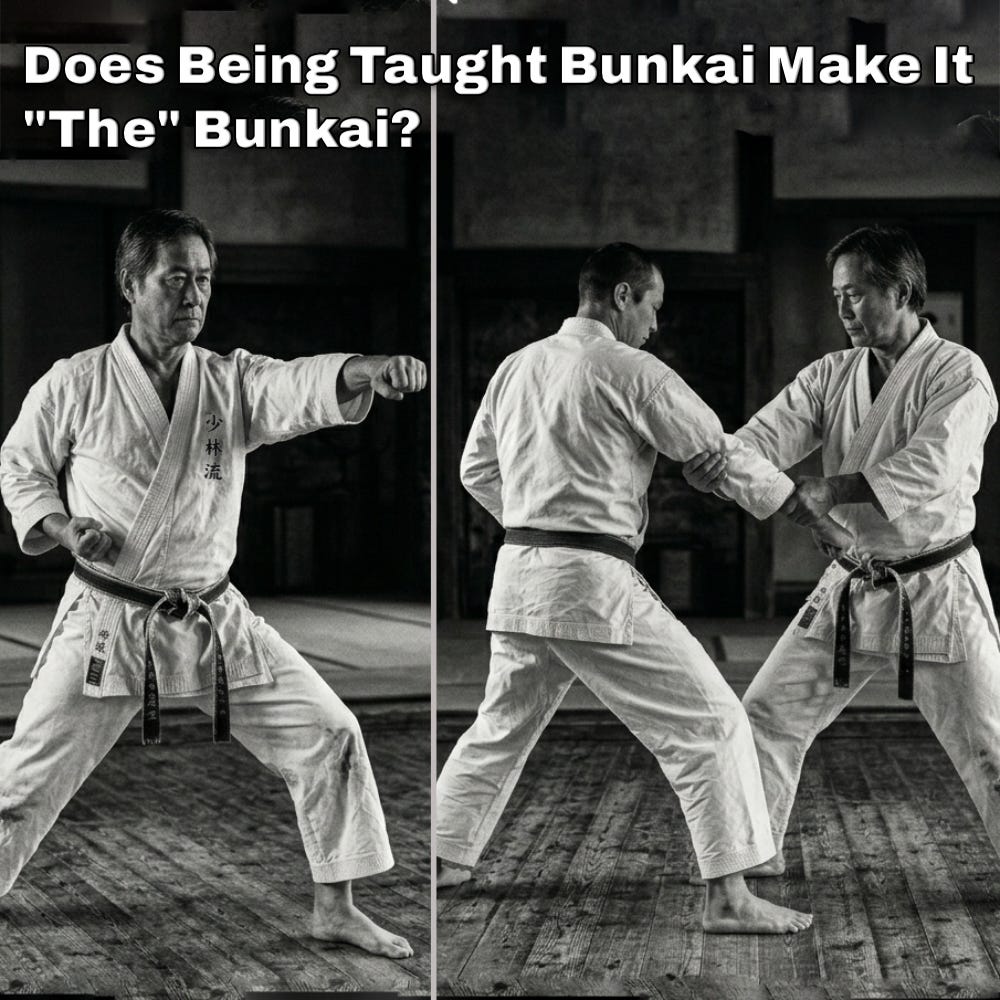
Does Being Taught Bunkai Make It "The" Bunkai?
When we reduce kata to single, fixed techniques, we miss the richer picture of what they are trying to teach us.

Following my recent article on kata applications, a familiar response appeared. The essence of it was simple enough:
“My instructor taught me the bunkai.”
Fair enough.
Before going any further, it’s worth acknowledging that while bunkai technically refers to the process of breaking down and analyzing a movement, most karate practitioners use the term when discussing applications. For the sake of simplicity, that is how I will use it here.
The interesting question is what conclusion should follow from the statement, “My instructor taught me the bunkai.”
When I suggest that kata movements may express principles rather than single fixed applications, some people hear something very different. They assume the argument is that nobody knows the bunkai. That is not what I am saying at all.
A more accurate way of expressing the idea would be this:
Even if we think we know the bunkai, that doesn’t necessarily mean it is the only valid expression of the principle.
That is a very different claim.
The interesting thing is that many practitioners unconsciously equate “I was taught this application” with “this is the application”. That leap is precisely what I like to challenge.
Let us assume for a moment that an esteemed instructor taught a specific application for a kata movement. Fine. That tells us he believed the application represented the movement. It may even be an excellent application. It may have been passed down through several generations of practitioners.
What it does not automatically tell us is that it was the original application, that it was the only application, or that the kata creator intended the movement to be restricted to that one use.
Those are different claims.
If we think about how martial arts are actually taught, the picture becomes even more interesting. Even instructors who believe in a correct bunkai will often demonstrate variations based on height, distance, timing, resistance, or circumstance. The moment that happens, we have already moved beyond a single fixed application and into the realm of principle.
When an instructor tells a student, “If your opponent is taller, change your angle”, or “If they grip you higher, drop your weight”, they are no longer teaching a fixed technique. They are proving the point without even realizing it.
A principle can produce many applications. A technique is only one expression of that principle.
What I suspect is happening is that many people see only two possibilities. Either there is one correct bunkai, or nobody knows anything and we are in to guesswork.
I do not believe the situation is nearly that simple.
We may not know the exact original intent behind every movement in every kata. At the same time, we can still identify principles, evaluate applications, pressure test ideas, and distinguish plausible interpretations from nonsense.
More importantly, we should be careful not to become trapped by the search for original intent.
Historical intent is interesting. Practical function is essential.
If an application fits the mechanics of the movement, functions under pressure, and makes sense within the context in which it is being used, then it has value. Whether we can prove it was the exact interpretation held by the kata’s creator is a separate question.
This is where I believe many discussions go off course. We become so focused on discovering what the creator intended that we forget to ask whether the movement is solving the problem in front of us.
Context matters.
A movement that works effectively in one situation may be entirely inappropriate in another. The application is always tied to the problem it’s trying to solve. That is why understanding principles is so important. Principles adapt. Fixed interpretations do not.
It’s also worth noting that when someone says, “My teacher taught me the bunkai for every movement”, they are actually answering a different question. We are not asking whether a teacher can teach bunkai. Of course they can. We are asking whether every movement has one and only one legitimate interpretation.
Those are not the same questions.
For some practitioners, certainty is comforting. The idea that a movement might encode a principle rather than a single technique can feel as though something is being taken away.
I would argue the opposite.
A movement that has only one application is limited. A movement that preserves a principle can adapt to countless situations.
That is not a lesser view of kata.
It is a richer one.
The value of kata does not lie in whether we can prove a single original application. Its value lies in preserving principles that continue to solve problems today.